
Here I want to record the following passage that concludes an essay discussing “magical realism” (I prefer magic realism–less clunky) as a narrative mode that, to varying degrees and with varying outcomes, (in simplistic terms) unites the real with the unreal. Magic realism normalizes or naturalizes supernatural, magical, surrealist, or fantastic narrative elements by contextualizing them with realism–that is, naturalistic, realistic detail and description, or normative terms.
First the passage.
Sweeping generalizations about magical realism are bound to fail; the term is best used not as a globalised postcolonial aesthetic category, but rather as a tool for understanding specific texts and contexts. Failing to recognize the differences between impulses behind magical realism has caused a great deal of confusion for literary criticism. Similarly, acknowledging such differences, but then falling back on the postmodern variety as a template against which other forms must be judged also leads to distorted interpretations. The way forward is to bear in mind that all criticism of any kind should always emerge out of a dialectic between the general and the specific. In this context that means above all resisting the urge to develop totalizing theories that cannot account for local difference, respecting the particular traditions and cultural currents that flow through magical realist texts, and ensuring, ultimately, that the text itself is allowed to enter into dialogue with the critical assumptions that seek to classify it. (12)
Warnes, Christopher. “Naturalizing the Supernatural: Faith, Irreverence and Magical Realism.” Literature Compass 2 (2005). 1-16.
Now a bit of rant-ridden rumination.
My paper on M. Wylie Blanchet’s The Curve of Time will examine how magic realism works to emphasise Blanchet’s encountering with place (pardon the potential pretentious ring there), and I am still working out how to authorize my discussion of this “mode” (I do like “mode”; that’s working for me). Certain literary and professorial types sometimes get a little blinky when I raise the issue, and honestly so do I, but the things that make me uncomfortable about it also make me want more.

(It’s related to the things that piss me off when people look at this regional space and call it paradise. Every time I hear someone do that, in that fucking voice, I think of the starving mangy cat on the road, untouchably affectionate and not yet dead, that must be cancelled–whether ignored, forgotten, or excused as “Mother Nature taking her course,” or otherwise obliterated from view–in order to maintain the roseappled vision of paradise, this healing place of abundant blessings to which we are CLEARLY entitled. Just cover the canker with a nice batik! wildcraft! motherfuck! blessed be!)
The interesting problem with magic realism is its sullying likeness to Orientalism, the colonialist attitude toward the other that leads keen Eurocentrics to embellish their curio cabinets with as many centaur women, enormous beetles, and forever formulas as possible. Stories of sasquatch, or of knowing things that haven’t happened yet, or of communicating with the dead, or dying and then living again, or scenes from the best shows watched altered late at night, become collections or guilty treats or silly stories allowed after the week, when all the real work is done. Don’t get me wrong–I am prone to involvement in all ways with this mode. THERE BE GIANT REVELATIONS WITHIN. The problem is the act of classification: certain things are real; other things are magic. The former governs, corrects, and houses the latter.
It is sincerely disappointing what a totalizing effect such problematics exact upon earnest and convoluted people like me. What. You don’t think I can come up with an excellent enough provisional definition that will grant the term’s passage into the pages of my Master’s Essay? To be fair, I am paraphrasing my interpretation of what the voices of those populating my paranoid fantasies say. But their faces uncannily resemble those of professors I know. They say, develop it; maybe they just mean, better you than me; I keep hearing, who do you think you are. It can be a little confusing at times.
Here is the painting by Harry Heine commissioned by Gray’s Publishing for the 1979 edition of The Curve of Time. I find it tremendously evocative of the drama and tone of the book.
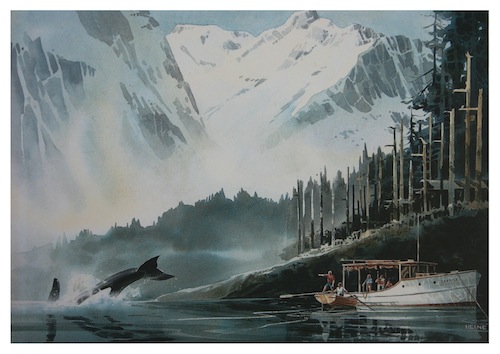
In bare bones summary, The Curve of Time is a collection of writings narrating Blanchet’s stories of exploring the west coast of British Columbia, through the Inside Passage, into Jervis Inlet, Desolation Sound, Knight Inlet, and through the Broughton Archipelago as far north as Cape Caution. The stories account for perhaps somewhat more than ten summers spent on a 25-foot motor boat with a very small cabin that, from the end of April until early September, housed Blanchet–known as Capi–, her five children, the family dog, and everything they needed to spend four months at a time cruising the lacy and remote coastline during the 30s and 40s. Much of the content details their visits to First Nations’ villages and grave sites, though any contact with members of these communities is glaringly omitted. The collection of stories subverts chronology and even the sense of time passing; in part through her imagining of the area as timeless (anachronistic space), the stories account for Capi’s deeply felt connection to the region–the place–as she explores, to the extent that, I argue, she naturalizes herself to the environment and indigenizes herself to the area, producing what amounts to be, in the final analysis, a land claim.
I am discussing the ways Blanchet uses what I take to be magic realism in order to communicate this deep sense of phenomenological encounters with the place. That she is indeed not indigenous, and is instead a white woman with a privileged background and first-class education, weighs heavily on her claim to this region, given its actual indigenous culture. She perceives the area as a kind of utopia and her children, being raised up for a good part of each year in its waterways, as paradisal little brown children mucking about in the tides, knowing what they are doing because that is what she has raised them up to do. (And that is as close as I can bear to come to what she actually calls them.) And why shouldn’t she? Her agility with the boat and the kids, and her constant awareness that is generous, untiring, and ferociously calm notwithstanding the inevitable bears, cougars, engine failures, weather, hauntings, visions, and all the rest earn her this place, don’t they. Even with the boatload of copper bracelets collected from the shores under broken cedar burial boxes?
I don’t have to be clear. Not here, not just yet. This is a collecting place.
I had meant to just jot the passage down for safekeeping. But things never quite go that way.
 thegoodbadpeople